Healing After an Affair: Finding a Way Forward

Finding a Way Forward
Discovering an affair can change the way you experience your relationship almost overnight.
Suddenly, you're questioning things you never thought you'd question. What was real? What did I miss? Can I trust this person again? Do I even want to?
And then comes the question I hear so often:
Can a relationship actually recover from this?
The answer isn't simple. But there is reason for hope.
Research has found that although couples dealing with infidelity may enter therapy experiencing significant relationship distress, they can make meaningful improvements during treatment. In one study, by six months after therapy, couples who had presented with infidelity were no longer significantly different on the measured outcomes from couples who had entered therapy for other relationship concerns (Atkins et al., 2010).
That doesn't mean every relationship survives an affair.
And I don't believe staying together should be the only measure of successful recovery.
Sometimes recovery happens together. Sometimes it happens separately.
But in either case, recovery is possible.

Affair Recovery Is a Process
One of the first things I want couples to understand is that affair recovery isn't usually one conversation, one apology, or one decision to forgive.
Gordon et al. (2004) describe recovery as moving through three broad stages: managing the initial impact, developing a greater understanding of what happened, and eventually determining how to move forward.
I appreciate this framework because it takes some of the pressure off having to figure everything out immediately.
When an affair has just been discovered, you may be angry one minute and devastated the next. You may desperately want answers and then realize you're not ready to hear them. You may want your partner close and then suddenly want nothing to do with them.
Trying to answer Are we staying together? while you're still trying to understand What just happened to my life? can be a lot to ask of yourself.
There also isn't a stopwatch for any of this.
Healing is rarely tidy. There can be better days followed by a reminder or trigger that brings everything rushing back. You may laugh together and then wonder whether you're supposed to be laughing yet.
Meanwhile, work still happens. Kids still need lunches. Groceries still need to be bought. The dog still needs to be walked.
Ordinary life continues alongside something that can feel anything but ordinary.
Progress doesn't always feel like progress while you're in it.

If You Were Betrayed
If you're the partner who discovered the affair, your first job isn't necessarily deciding whether you're going to stay.
You may be dealing with anger, grief, confusion, intrusive thoughts, repeated questions, or an overwhelming need to understand what happened.
You might have a relatively good day and then be blindsided by a song, a place, a date, or a notification on a phone that wouldn't have meant anything to you before.
You don't need to hurry toward forgiveness. And you don't need to force yourself to trust again because someone tells you it's time.
Early recovery may simply mean understanding your reactions, identifying what you need to feel safer, establishing boundaries, deciding what information you need, and beginning to find your footing again.
And there's an important distinction here:
You can actively participate in your own healing without taking responsibility for your partner's decision to have an affair.
Those are two very different things.

If You Had the Affair
If you're the partner who had the affair, your work will look different.
Accountability matters.
That may mean being honest about what happened, answering difficult questions, respecting boundaries, ending inappropriate outside contact, and recognizing that trust usually isn't rebuilt because you've said, You can trust me now.
It's rebuilt through what happens next.
Through consistency. Transparency. Follow-through. Difficult conversations. And behaviour that begins to match what you're saying.
There may also be some uncomfortable questions to ask yourself.
What allowed you to cross a boundary in your relationship? What did you minimize, avoid, compartmentalize, justify, or fail to communicate?
And perhaps most importantly:
What needs to change so that you can become a safer partner going forward?
Accountability doesn't mean living permanently in shame.
The goal isn't punishment. The goal is understanding what happened, taking responsibility for it, and doing something meaningful with that understanding.

If You Decide to Work on the Relationship Together
If both partners eventually choose reconciliation, some of the work becomes shared.
You may need to look at patterns that existed before the affair, develop clearer boundaries, communicate differently, rebuild emotional and physical intimacy, or understand how the two of you gradually became disconnected.
But I want to make an important distinction.
Exploring problems that existed within a relationship is not the same as assigning responsibility for the affair.
Two people can contribute to difficulties within a relationship. The decision to cross an agreed-upon relationship boundary belongs to the person who made that decision.
We can ask, What was happening between us? without turning that into, You made me do this.
Understanding the relationship isn't about finding someone else to blame.
It's about understanding it well enough to decide what needs to be different going forward.

Small Steps Forward
One of the things I often remind couples is that affair recovery is an active process.
But that doesn't mean you need to spend every waking moment working on your relationship.
Actually, please don't.
Sometimes part of healing is going for a walk. Seeing a friend. Getting some sleep. Going to the gym. Spending time with your kids. Watching something that has absolutely nothing to do with relationships.
Sometimes it's looking at your partner and saying, We've talked about this enough for tonight.
There is room for rest in recovery too.
At the same time, recovery doesn't happen only during the hour you spend with your therapist.
Some of the work happens together in couples therapy. Some happens individually. And a lot of it happens during the ordinary days between sessions.
It might mean completing an exercise your therapist has given you. Journalling. Recognizing a trigger before reacting to it. Practising a different response. Having an intentional conversation. Establishing a boundary. Reading something helpful.
Sometimes recovery means doing something.
Sometimes it means learning something.
And sometimes it means knowing when you've done enough for today.
Small steps count.

A Quick Word About the 37 Videos You're About to Watch at 2 a.m.
Something painful happens and we do what people do now.
We reach for our phones.
Before you know it, you're 37 videos deep into cheating, betrayal trauma, attachment styles, narcissism, "signs they'll cheat again," and whether your relationship is doomed.
And suddenly, a stranger on the internet seems to know an awful lot about your relationship.
There are excellent clinicians, researchers, and educators sharing information online. There is also an enormous amount of relationship content designed primarily to attract attention, views, shares, and engagement.
Those aren't necessarily the same thing.
So I encourage people to ask two questions.
Who is giving me this information?
Look at their qualifications. Look at where their information comes from. Be curious about whether you're hearing established clinical information, someone's personal experience, or an opinion presented as fact.
Then ask:
How do I feel after consuming it?
Is it helping you understand what you're experiencing? Is it giving you language for something you couldn't explain? Is it giving you something useful to bring into therapy?
Or are you becoming more anxious and searching for one more explanation, one more sign, one more label, or one more reason to be afraid?
Sometimes learning is part of recovery.
And sometimes putting the phone down is part of recovery too.
Reading Can Be Part of the Work
I love a good therapy book.
But a book isn't therapy.
It doesn't know your relationship history, the circumstances surrounding the affair, your attachment histories, previous injuries, current safety, or whether either of you even wants reconciliation.
What a good book can do is give you language. It can help you understand your reactions, give you questions you hadn't thought to ask, and sometimes provide that moment of:
Okay. I'm not the only person who has felt this way.
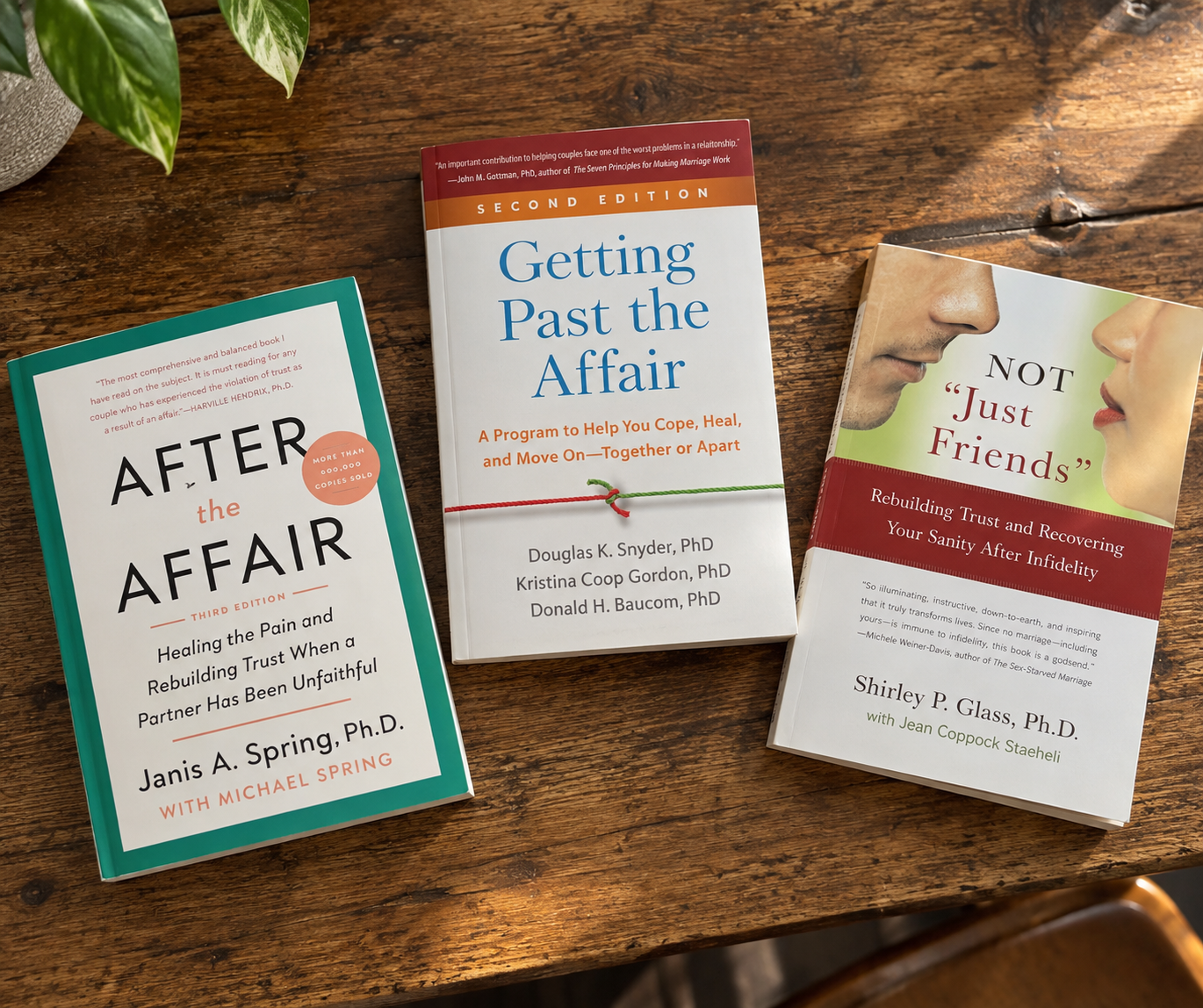
These are three books that have given me something worth thinking about.
1. Not "Just Friends" by Shirley P. Glass, PhD
Not "Just Friends" explores emotional and sexual affairs, secrecy, boundaries, betrayal, and rebuilding trust.
But there's one idea from this book that has stayed with me more than anything else.
Walls and Windows
Glass uses the metaphor of walls and windows to describe the boundaries that protect a relationship.
In a secure relationship, there is a window between partners where there can be openness, honesty, vulnerability, and emotional intimacy. Appropriate walls or boundaries help protect that relationship from outside connections becoming inappropriately intimate.
What struck me about this concept is how quietly those walls and windows can shift.
Sometimes we begin closing the window to our partner.
We stop telling them about the difficult day at work. We don't share the insecurity we've been carrying or the thing that made us laugh. Maybe conversations have become difficult. Maybe we don't feel understood.
Little by little, we share less.
At the same time, we may begin opening a window somewhere else.
Maybe it's a coworker who always seems to understand. An old friend who reaches out online. Someone we start messaging more frequently.
The conversations may initially seem completely innocent. But gradually, that person begins receiving parts of us that we are no longer bringing home to our partner.
Glass describes the danger as essentially reversing the walls and windows. A wall begins developing between partners through secrecy or emotional distance, while a window of intimacy opens toward someone outside the relationship.
This doesn't mean people in committed relationships shouldn't have meaningful friendships or close connections outside their partnership.
Of course they should.
For me, the more useful question is:
Where are your windows open, and where have you started building walls?
That's a question worth asking long before an affair ever happens.
2. Getting Past the Affair by Douglas K. Snyder, Kristina Coop Gordon & Donald H. Baucom
This book offers a structured approach to understanding and recovering from infidelity.
What I appreciate most is that it doesn't begin by assuming what the ending should be.
You Don't Need to Know the Ending Yet
The approach developed by Snyder, Gordon, and Baucom moves through three broad stages: managing the impact, making meaning of what happened, and moving forward (Gordon et al., 2004).
That makes a lot of sense to me.
The first stage is about getting through the impact.
When an affair has just been discovered, emotions can be intense. Conversations can escalate quickly. The relationship you thought you understood may suddenly look very different.
At that point, perhaps the most important task isn't deciding its future.
It's getting through what just happened.
The second stage creates room for understanding. That may involve looking at individual vulnerabilities, relationship patterns, circumstances, outside stressors, and the series of choices that contributed to what happened.
But again:
Understanding is not the same as excusing.
Then comes moving forward.
For some couples, that means reconciliation.
For others, it means deciding that the relationship will end and beginning the work of healing separately.
What I appreciate about this framework is that it gives people permission not to know the ending while they're still trying to understand what happened.
You don't necessarily need to know today whether you'll forgive.
You don't need to know whether you'll stay together.
There may be work that needs to happen before you're ready to answer those questions.
And if you eventually choose reconciliation, I don't think the goal necessarily needs to be getting back to the relationship you had before.
Something significant has happened.
Perhaps the more useful question becomes:
If we choose each other again, what do we want this relationship to look like now?
3. After the Affair by Janis Abrahms Spring, PhD
After the Affair explores the emotional aftermath of infidelity, recommitment, rebuilding trust, forgiveness, and intimacy.
But one fairly simple idea from Spring has stayed with me:
Love is not static.
Relationships Move
I appreciate this idea because I think we sometimes carry an unrealistic expectation that if a relationship is healthy, we should always feel close, connected, attracted, and completely satisfied with one another.
Real relationships don't usually work that way.
There are seasons when couples feel deeply connected and seasons when they feel further apart.
Careers become demanding. Children need us. Stress increases. We experience grief, illness, aging, transitions, resentment, exhaustion, and sometimes simply the routines of everyday life.
Sometimes partners turn toward one another easily.
Sometimes they lose sight of each other for a while.
What I appreciate about Spring's perspective is the reminder that distance doesn't necessarily mean the relationship is over.
Sometimes it means something in the relationship needs attention.
That doesn't excuse an affair. Feeling lonely, disconnected, dissatisfied, or unseen doesn't make infidelity inevitable, and it doesn't transfer responsibility for an affair onto the other partner.
But it does give us something important to think about.
Can we notice when we're beginning to drift apart?
Can we talk about dissatisfaction before it becomes resentment?
Can we recognize when we're becoming emotionally disconnected and intentionally begin turning toward one another again?
And can we remember that a difficult season in a relationship doesn't necessarily predict how that relationship will always feel?
Relationships aren't static.
Neither is love.

A Couple of Bonus Reads
Two other books are worth mentioning, but for different reasons.
The State of Affairs by Esther Perel is less of a step-by-step recovery guide and more of an exploration of infidelity itself. It looks at betrayal, desire, relationships, and the complicated meanings people can make of affairs.
I wouldn't necessarily hand it to everyone in the immediate aftermath of discovering an affair. But for someone wanting to think more deeply about infidelity and relationships, it can offer another perspective.
Hold Me Tight by Dr. Sue Johnson isn't specifically about affair recovery. It's about attachment, emotional responsiveness, and the bond between partners.
For couples who are further along in recovery and beginning to ask not only How do we survive what happened? but How do we create a relationship where we can reach for one another differently?, I think it can be a valuable addition.

A Personal Reflection
Infidelity is a topic that has touched my own life as well, and perhaps that is one reason I have such an appreciation for how complicated recovery can be.
When I look back on my own experience, there was a time when I took what had happened very personally and carried responsibility that, in hindsight, wasn't entirely mine to carry.
Part of my recovery involved understanding what had happened.
But it also involved understanding myself.
I began to recognize what I was carrying that wasn't mine to carry, what I needed from a relationship, and what I could no longer accept.
Eventually, healing for me meant walking away from that relationship and finding a way forward on my own.
That was my path.
It doesn't mean it needs to be someone else's.
In fact, I think my own experience is part of what allows me to sit with couples today without needing to decide the ending for them.
As a couples therapist, my role isn't to convince someone to stay.
And it isn't to tell someone to leave.
It's to help people slow things down, understand what has happened, recognize what they need, and make their own decisions about what moving forward looks like.
Perhaps somewhat unexpectedly, an experience that was deeply personal to me eventually became part of what drew me toward supporting other people through these incredibly complicated moments in their relationships.
And it taught me something I continue to carry into my work:
Recovery isn't measured only by whether a relationship survives.
For me, recovery meant finding healing outside of the relationship.
For someone else, recovery may mean two people choosing each other again and doing the difficult work of rebuilding trust, safety, and connection.
Neither path erases what happened.
Sometimes healing happens together.
Sometimes healing happens separately.
Both are still healing.
When Might Couples Therapy Help?
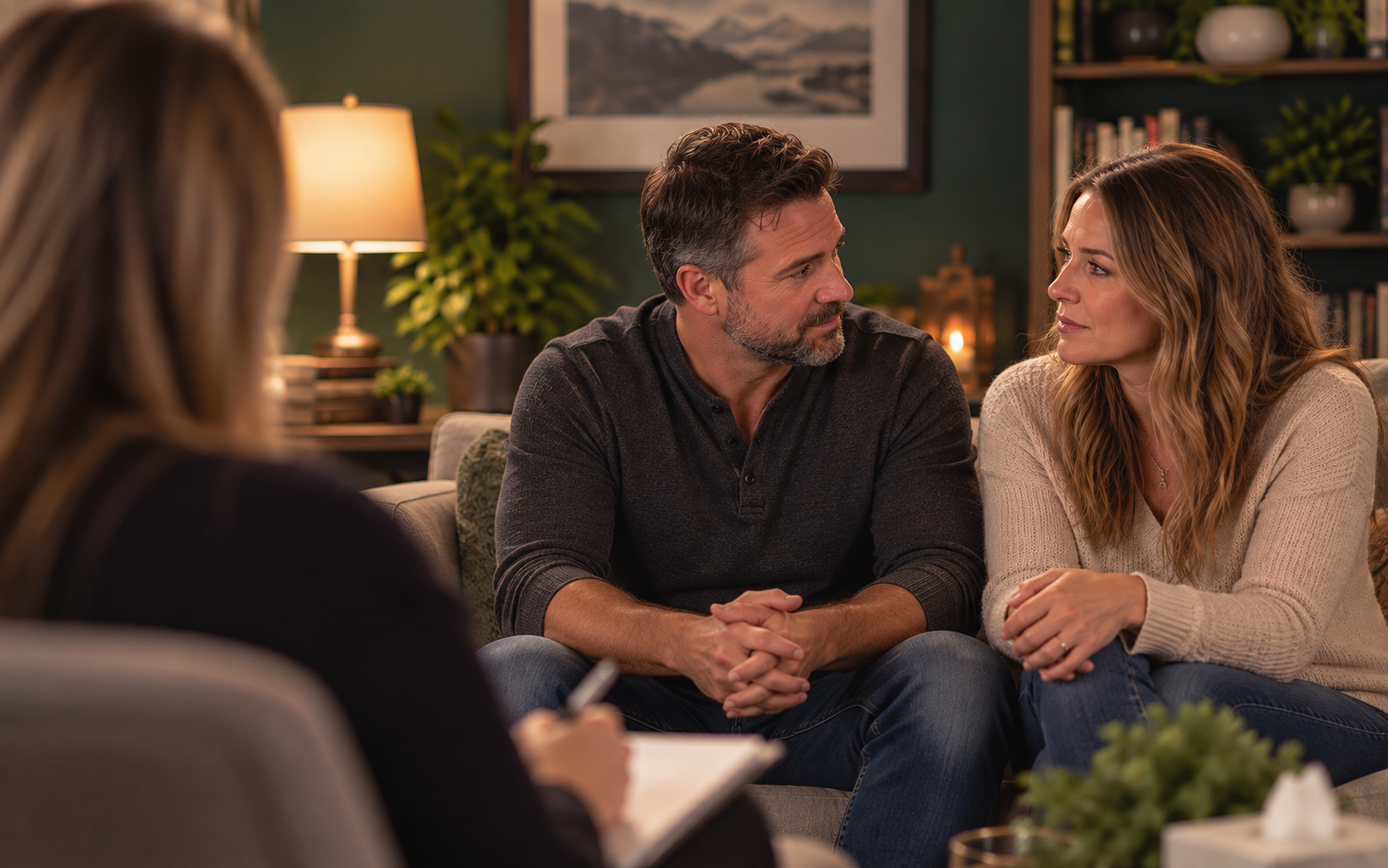
You don't have to wait until you've decided whether you're staying together to come to couples therapy.
Sometimes that's exactly what brings people through the door:
We don't know what we're doing yet.
That's okay.
Therapy can give you a place to slow things down when conversations at home keep going in circles. It can help you understand triggers and reactions, talk about accountability and boundaries, and begin making sense of what has happened.
There is also reason for hope.
Atkins et al. (2010) found that although couples presenting with infidelity began therapy experiencing greater relationship distress and depressive symptoms than couples seeking therapy for other concerns, they improved during treatment. At six-month follow-up, the groups were no longer significantly different on the outcomes examined.
I think that's important because affair recovery can feel incredibly hopeless when you're standing at the beginning of it.
Therapy doesn't guarantee reconciliation.
And reconciliation isn't always the goal.
Sometimes therapy is about rebuilding a relationship.
Sometimes it's about determining whether you want to rebuild it.
And sometimes it's about helping two people move through the ending of a relationship with greater understanding and care.

You Don't Have to Decide Everything Today
If you've recently discovered an affair, you may feel enormous pressure to figure out what happens next.
Am I staying?
Can I forgive this?
Will I ever trust again?
Is our relationship over?
Those are important questions.
You don't necessarily need to answer all of them today.
Recovery can begin much smaller than that.
One conversation.
One boundary.
One therapy appointment.
One chapter of a book.
One evening when you've talked enough and decide to order pizza instead.
One small step forward.
And tomorrow, you can decide what the next one looks like.
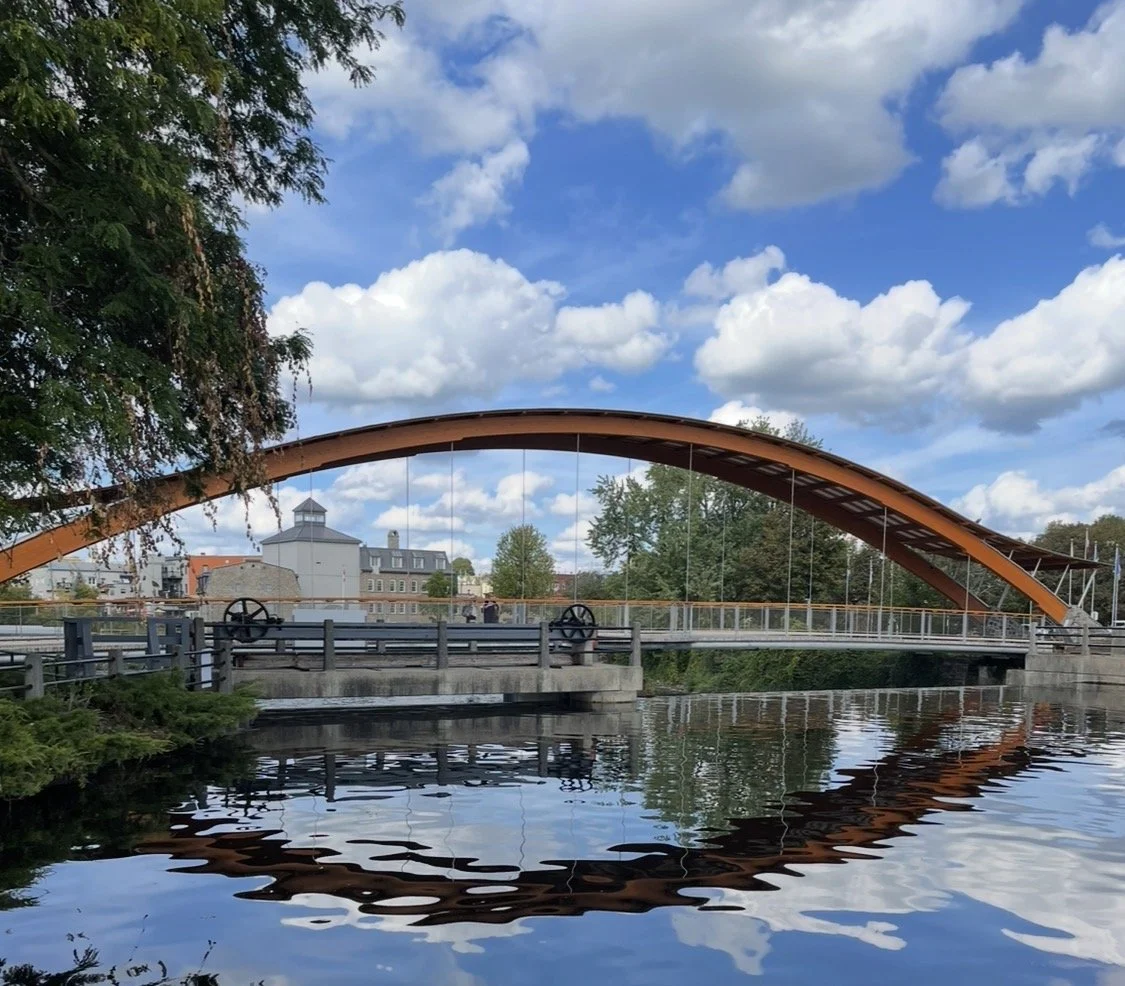
Confederation Drive Pedestrian Bridge, Smiths Falls, Ontario. Photo by Diane Marie Watkins.
Looking for Support?
If infidelity has affected your relationship, you don't have to arrive at therapy already knowing whether you want to stay together.
At Watkins Counselling & Wellness, Joe-Ann Watkins, Registered Psychotherapist and couples therapist, offers a place to slow things down, understand what has happened, and explore what recovery might look like for you.
Couples counselling is available in Smiths Falls and virtually across Ontario, and a complimentary 20-minute phone or video consultation is available if you'd like to see whether working together feels like the right fit.
— Joe-Ann Marie Watkins, Registered Psychotherapist
Date: September 20, 2026
Watkins Counselling & Wellness — Helping You Reconnect, Heal, and Grow
References & Recommended Reading
Atkins, D. C., Eldridge, K. A., Baucom, D. H., & Christensen, A. (2005). Infidelity and behavioral couple therapy: Optimism in the face of betrayal. Journal of Consulting and Clinical Psychology, 73(1), 144–150.
Atkins, D. C., Marín, R. A., Lo, T. T. Y., Klann, N., & Hahlweg, K. (2010). Outcomes of couples with infidelity in a community-based sample of couple therapy. Journal of Family Psychology, 24(2), 212–216.
Glass, S. P., & Staeheli, J. C. (2003). Not "Just Friends": Protect your relationship from infidelity and heal the trauma of betrayal. Free Press.
Gordon, K. C., Baucom, D. H., & Snyder, D. K. (2004). An integrative intervention for promoting recovery from extramarital affairs. Journal of Marital and Family Therapy, 30(2), 213–231.
Gordon, K. C., Baucom, D. H., & Snyder, D. K. (2005). Treating couples recovering from infidelity: An integrative approach. Journal of Clinical Psychology, 61(11), 1393–1405.
Snyder, D. K., Gordon, K. C., & Baucom, D. H. (2023). Getting past the affair: A program to help you cope, heal, and move on, together or apart (2nd ed.). Guilford Press.
Spring, J. A. (2020). After the affair: Healing the pain and rebuilding trust when a partner has been unfaithful (3rd ed.). HarperCollins.
Perel, E. (2017). The state of affairs: Rethinking infidelity. Harper.
Johnson, S. M. (2008). Hold me tight: Seven conversations for a lifetime of love. Little, Brown.